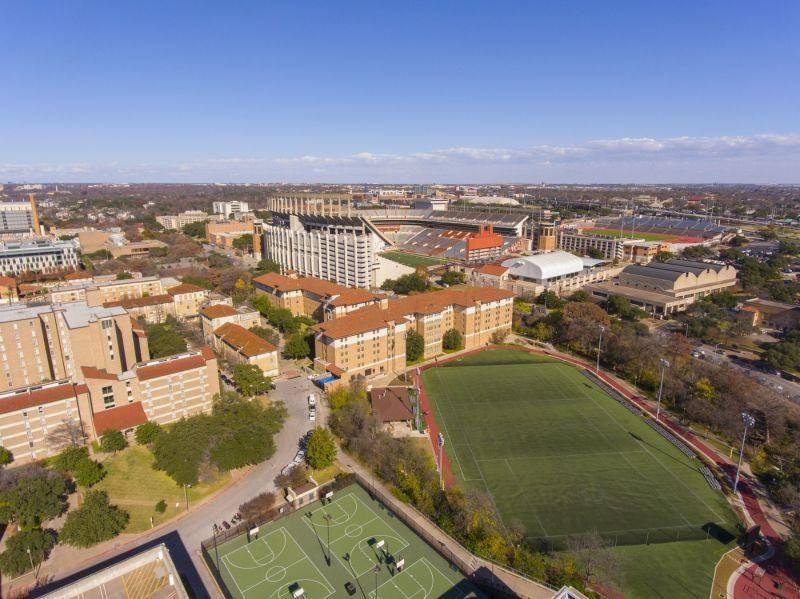
There is a question at the center of this story.
If a city builds its identity around education, if its economy runs on a university, if its streets are named after scholars, and if its residents hold advanced degrees at rates that outpace much of the country, what does it mean when that city’s public schools leave Black children behind at every grade level tested, in every subject, year after year?
That is not a hypothetical.
That is College Station, Texas.
What the data shows
College Station ISD appears five times on our list of the 50 highest-rated Texas schools where Black students are being left behind, more than any other district in the state. Only one other district, Frisco ISD, appears as many as four times, and Frisco serves nearly four times as many students. The concentration of the problem in College Station is not explained by size. It is consistent and unmistakable.
Here is what the 2024-25 TEA TAPR data shows across College Station ISD schools:
A&M Consolidated Middle School
285 Black students. Overall pass rate: 74%. Black student pass rate: 41%. Gap: 33 percentage points across all subjects. In math, Black students pass at 31% compared with 71% schoolwide, a 40-point gap in a single subject at a single school.
Wellborn Middle School
285 Black students. Overall pass rate: 86%. Black student pass rate: 56%. Gap: 30 points. In a school where nearly 9 in 10 students are meeting the standard, barely more than half of Black students are.
Pecan Trail Intermediate
176 Black students. Overall pass rate: 86%. Black student pass rate: 55%. Gap: 31 points. In math, Black students pass at 53% while the school overall passes at 87%.
Cypress Grove Intermediate
218 Black students. Overall pass rate: 77%. Black student pass rate: 52%. Gap: 25 points.
College Station High School
405 Black students. Overall pass rate: 87%. Black student pass rate: 69%. Gap: 18 points.
A&M Consolidated High School
391 Black students. Overall pass rate: 87%. Black student pass rate: 72%. Gap: 15 points.
The gap does not disappear as students get older. It follows them. A Black child who enters College Station ISD in elementary school and remains through graduation can spend 13 years in a system where academic outcomes consistently trail those of their peers by 15 to 40 percentage points. The system does not appear to narrow those gaps over time. The pattern remains.
The math gap is the most alarming finding
Across every College Station ISD school on this list, math gaps are consistently larger than English language arts gaps.
At A&M Consolidated Middle, Black students pass math at 31%. At Wellborn Middle, 58%. At Pecan Trail Intermediate, 53%. At Cypress Grove Intermediate, 55%.
Math is a gateway subject. Success in middle school algebra opens doors to advanced math in high school, which in turn expands access to STEM majors, technical careers, and many of the highest-paying professions. A 40-point math gap in middle school is not simply an academic concern. It is a pipeline issue. Students who fall behind there often face fewer opportunities long before they apply to college.
That reality carries particular weight in a city whose largest employer is a university known for producing engineers.
The scale is significant
This is not a story about a handful of students.
Across these schools, hundreds of Black students are represented in the data. A&M Consolidated Middle School alone enrolls 285 Black students. College Station High School enrolls 405.
These are not statistical anomalies. They are children, and there are enough of them to make the pattern difficult to dismiss.
What makes College Station different
Every district on the worst-schools list has its own story.
Many rural districts in East Texas face genuine resource constraints. Small communities with limited tax bases confront structural challenges that are well documented.
College Station does not fit that profile.
Texas A&M University is the economic engine of the Brazos Valley. It employs thousands of people, generates billions in economic activity, and produces research on education, child development, and educational equity. Few school districts have comparable access to expertise and institutional resources.
Yet the data still shows Black students falling behind at every grade level represented here.
That raises a difficult question.
If the resources exist, why do the gaps persist?
The questions College Station ISD needs to answer
What percentage of Black students are enrolled in gifted and advanced coursework compared with their white peers?
What does the discipline data show for Black students at each school?
What specific interventions are in place for Black students performing below grade level?
What professional development has the district provided to teachers on addressing racial achievement gaps?
What does the district’s strategic plan say specifically about improving outcomes for Black students?
These are not unfair questions. They are questions any district should be prepared to answer when its public data looks like this.
The data is public.
The accountability should be, too.
A note to College Station ISD
This story is not an attack.
It is a mirror.
The achievement gaps in your district are documented, consistent, and significant. They appear in elementary school and remain through high school. That information is already available to your district.
The question is what you choose to do with it.
Black families in College Station deserve a district that acknowledges these gaps, measures its progress honestly, and commits to closing them.
Not in a press release.
In the data.
The same data that revealed this pattern will also show whether it changes.
We will be watching.
Data source: Texas Education Agency TAPR 2024-25. All figures reflect students meeting the Approaches Grade Level standard or higher on STAAR assessments. Data tool available at texastea.hbcugrad.org.